
-Where cultures meet-
Language Open Day is a student-led, community-driven initiative that connects Palestine to the world through culture, language, and meaningful engagement. It was launched in 2015 by the Language Resources Center at An-Najah National University to transform the campus into a vibrant, inclusive, and globally connected cultural space.
The initiative brings together university students, school students, local communities, and international partners in a unique environment that celebrates linguistic and cultural diversity
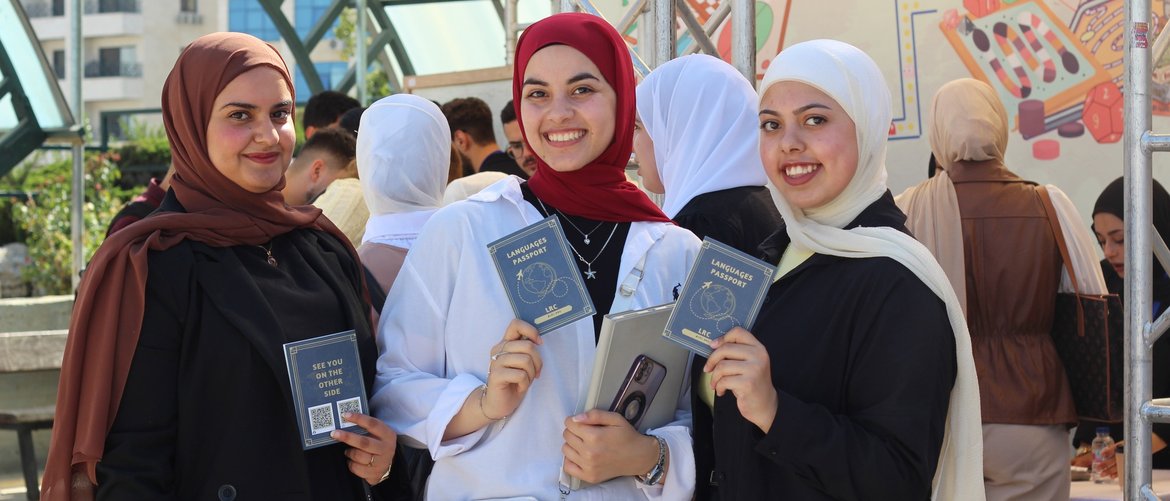


The Language Resources Center (LRC) Introduction Corner aims to introduce visitors to the center’s mission and its role in supporting language learning and developing linguistic skills within an interactive educational environment. The center offers a variety of learning resources, including audio-visual materials, practical activities, and spaces designed for both self-directed and collaborative learning, serving learners of different levels.
Through this corner, visitors learn about the services provided by the Language Resources Center, the languages it supports, and how to benefit from its resources in both academic and extracurricular contexts. The corner also serves as the reception and guidance point for the Open Languages Day, where event “passports” are distributed. These passports allow participants to move between different language corners and collect stamps, creating an interactive experience that encourages exploration and active engagement
This cultural and linguistic booth aims to introduce visitors to the Arabic language and its rich heritage through an engaging, interactive experience. By offering a variety of games and activities designed to test knowledge and spark curiosity, the booth provides visitors with a hands-on opportunity to learn through active participation.
The booth features a diverse range of interactive activities, starting with a challenge that pairs images of iconic Arab landmarks with their respective national flags, effectively testing and expanding the visitors' geographical knowledge. In another section, participants are presented with brief biographical snapshots of celebrated Arab authors and poets, challenging them to guess the names behind the literary legacy. Additionally, the booth showcases visual puzzles where colloquial Arabic proverbs are represented through illustrative imagery. This specific activity highlights that the Arabic language beautifully encompasses both formal and colloquial forms, emphasizing that proverbs remain a cornerstone of Arab cultural identity.
Furthermore, the experience includes linguistic puzzles where visitors reassemble scrambled Classical Arabic words to uncover correct synonyms, alongside an exploration of Arabic calligraphy. In the latter, participants identify various traditional scripts by matching written samples with their correct names. Ultimately, this booth seeks to present Arabic as a vibrant, versatile, and beautiful language. By utilizing fun and interactive methods, it aims to foster a deeper appreciation and revitalize interest in the language among native-speaking university students.
The English language is one of the most widely spoken languages in the world, used by millions of people as a native or second language. It originated in England and developed over centuries, influenced by Germanic and Latin languages, before spreading globally through British expansion.
Today, English is mainly represented through British and American cultures. British culture is known for its long history, classical literature, the monarchy, and strong traditions. American culture, on the other hand, is famous for its diversity, openness, and global influence in movies, music, technology, and modern lifestyle. Despite differences in accent and vocabulary, the English language remains a cultural bridge that connects both cultures and influences the entire world.
Turkish culture is rich and diverse, combining deep Ottoman history with modern life. Turkey is known for its famous landmarks such as the Blue Mosque, Cappadocia, and Pamukkale.
Turkish people are known for their hospitality, and tea is an essential part of daily life and social interaction. The Turkish language is widely spoken in Turkey and Northern Cyprus and belongs to the Turkic language family. Turkish culture remains strongly present in traditions, arts, and humanitarian values.
The Italian cultural booth featured a hands-on and interactive experience, divided into multiple sections covering language, cuisine, landmarks, historical figures, and modern industries. Games, quizzes, and simple activities were incorporated as core tools to convey information, based on the principle that learning becomes more effective and memorable when it is engaging and non-traditional
it also emphasized connections between Italian culture and visitors’ everyday lives, highlighting similarities with Arab traditions, such as the extensive use of olive oil and the social role of food. In addition, it provided practical insights into the Italian language, famous cities and landmarks, Renaissance figures, sports icons, and notable industries, supported by visual materials and artworks, offering a clear and accessible overview of Italian culture
The German corner introduced visitors to German culture, which is known for its organization, precision, and strong emphasis on work and education. It also highlighted the German language as one of the most widely spoken languages in Europe, with roots in the Germanic language family, and its use today in fields such as science, engineering, and business, making it a language of global importance.
Korean culture is well known worldwide for its diversity and for blending ancient traditions with modern life. Some of its most famous features include Korean food like kimchi and bibimbap, the global popularity of skincare, and famous landmarks such as Gyeongbokgung Palace and Jeju Island. Koreans value respect and order, and it is common to take off shoes when entering a home. Also, writing names in red is avoided because it is associated with death
The Korean language is called “Hangul,” a writing system created by King Sejong the Great in the 15th century so that ordinary people could read and write easily instead of using difficult Chinese characters.
Today, Korean is spoken in South and North Korea and has become globally popular because Korean dramas and K-pop , Hangul is known as one of the simplest and most logical writing systems in the world.
Japanese culture is characterized by great respect for customs and traditions. This respect appears in daily behaviors such as bowing as a means of greeting and showing appreciation, especially toward the elderly. Japanese culture is also based on discipline, order, teamwork, and respect for time values that are clearly reflected in everyday life. Japanese people care a lot about cleanliness and order, and they don’t start eating before others.
Japanese culture is also distinguished by its traditional arts and rituals that express harmony, calmness, and beauty, as the Japanese people are naturally calm and harmonious. Among these rituals are the tea ceremony, which symbolizes calmness and respect; the art of flower arrangement (Ikebana); and Japanese calligraphy, which reflects simplicity and balance. Interest in cultural identity is also evident in traditional clothing such as the kimono, which is worn on formal occasions and during popular festivals that reflect the Japanese people’s connection to nature and the changing seasons. In this way, Japanese taste is embodied in colors, details, and precision.
The Japanese language is considered an essential part of the culture, as it is distinguished by the use of multiple writing systems. Three main systems are used: Kanji, derived from Chinese and used to express meanings; Hiragana, used for native Japanese words and grammatical endings; and Katakana, used for foreign words, reflecting the richness and precision of the Japanese language.
Japanese Section:
The Japanese corner was divided into three sections to offer visitors a well-rounded experience
-in the culture and language section: we presented an overview of Japanese culture and everyday values We also introduced the Japanese language in a simple way including its writing systems and we taught visitors a few easy words and phrases for greetings and self-introduction.
-Interactive Games Section: We dedicated a section to games and interaction to encourage active participation We offered interactive activities such as a Kahoot quiz an anime emoji guessing game and an origami challenge which made the experience livelier and more enjoyable.
-Food and Tasting Section: In the food and tasting section, we combined brief explanations with hands on experience We introduced some of the most popular Japanese foods and offered tastings such as ramen sushi and mochi This section attracted many visitors because it allowed them to explore the culture through food.
The Sign Language Corner aims to introduce students to sign language and Deaf culture through an interactive and experiential approach. Upon entering the corner, students receive a card that says, “Today, you are part of the Deaf community. Communicate with your friends using sign language only,” encouraging them to experience non-verbal communication. Images of sign language letters and basic words are displayed on a screen to support understanding, while cards showing signs and their meanings are placed on the table. Students take part in an educational game where they guess a name or a word using signs and letters, then try to spell their own names using sign language letters, making the learning process fun and engaging. Throughout the activity, students communicate with each other using only sign language, helping them understand the importance of visual communication and the experience of the Deaf community. The corner also includes a learning tree where students add what they have learned, such as new sign language vocabulary, information about Deaf culture, or their reflections, promoting awareness, respect, and acceptance of differences.
We organized a special interactive corner dedicated to Russian culture, welcoming the Russian delegation from Bethlehem. The event offered a rich cultural experience reflecting the depth and diversity of Russia’s heritage, where historical roots blend with elements of modern life. The program featured three engaging sections, starting with the informational corner, which included interactive activities such as a True or False game about Russia and a word-matching game connecting Russian words with their correct cards, creating a fun and educational atmosphere. This was followed by the games corner, featuring a fast-paced chess match between participants, along with a modern-style version of Shashki (Russian checkers). The event concluded with the cultural corner, highlighting prominent Russian writers and figures, as well as traditional folk tales and famous Russian cartoon characters. It was a well-rounded experience combining knowledge, interaction, and cultural entertainment.
The Games Booth was designed as an interactive space that supports language learning through hands-on experience and active engagement. It featured a selection of educational games, including Scrabble, Heads Up, Countries Puzzle, Who Am I, and Pictionary, each contributing to the development of different language skills such as vocabulary enrichment, oral communication, comprehension, and creative thinking.
The corner relied on game-based learning as a core approach to presenting language concepts, based on the belief that engagement and enjoyment enhance understanding more effectively than traditional methods. In addition, the Games Corner created an energetic and welcoming atmosphere that encouraged visitors to participate, interact comfortably, and practice language skills with confidence, resulting in a smooth and enjoyable learning experience.
The Contests Corner featured an interactive activity designed as a spinning wheel decorated with playing card symbols. Participants spun the wheel to determine the type of challenge. The activities included locating countries on a world map, listening to song clips and identifying their language, a flip-and-match game, coloring activities, as well as interactive quizzes and competitions conducted through Kahoot. The Joker symbol granted an automatic win without completing a challenge. This corner aimed to enhance language awareness through an engaging and enjoyable learning experience, while encouraging student participation and offering successful participants the opportunity to enter a daily lucky draw for a free language course provided by the Language Resource Center (LRC).
Language Open Day has developed strong and sustained collaborations with international cultural institutions, diplomatic representations, and global partners, transforming the initiative into a platform for meaningful cross-cultural dialogue.
These partnerships play a vital role in enriching the authenticity and diversity of the event, with representatives contributing directly to cultural booths, interactive activities, and educational engagement.
Notable collaborations include international cultural centers and representatives from countries such as Korea, Turkey, France, Russia, Japan, and Spain, among others.
These partnerships are not symbolic; they are active and ongoing, contributing to the design, delivery, and continuous development of the initiative.
Evidence and Testimonials
The impact and success of Language Open Day are strongly supported by a wide range of qualitative and visual evidence.
This includes:
Video documentation showcasing student-led activities and cultural performances
Testimonials from international partners highlighting the uniqueness and impact of the initiative
Reflections from student volunteers demonstrating personal and professional growth
Media coverage and institutional documentation
One international representative described the initiative as:
“A unique platform where students express their passion for languages and cultures while building real connections with the world.”

Jamal Ilaiwi
Lama Abu Baker

Tala malhas

Aya Jabi

Jana Numoor
Article:
- جامعة النجاح الوطنية - مركز موارد اللغات في جامعة النجاح الوطنية ينظم فعالية يوم اللغات المفتوح (najah.edu)
- اليوم المفتوح للغات في "النجاح": تنوع ثقافي وتعزيز للمهارات التواصلية (najah.edu)
Reel:
- https://www.facebook.com/share/v/1CgxPcXYVm/ (new campus)
- https://www.instagram.com/reel/DQUt2MuDXik/?igsh=NGRxZW9jNHZhbXdl (old campus, language passport concept)
Photo album:
Sponsors:

